
ISTANBUL AIRSHOW, International Civil Aviation and Airports Exhibitions has been organized biannually at Istanbul Atatürk Airport since 1996.
The Event is unique by being the single ‘Civil Only’ aviation platform extending from Eastern Europe to Central Asia including North Africa and the Middle East. In Istanbul Airshow, the Commercial, Business & General Aviation, and Airports segments of the industry are brought together under one unified organization. Aligned with the changing needs of the industry, especially in the event’s target Region, increased emphasis will be given to key regional priorities.
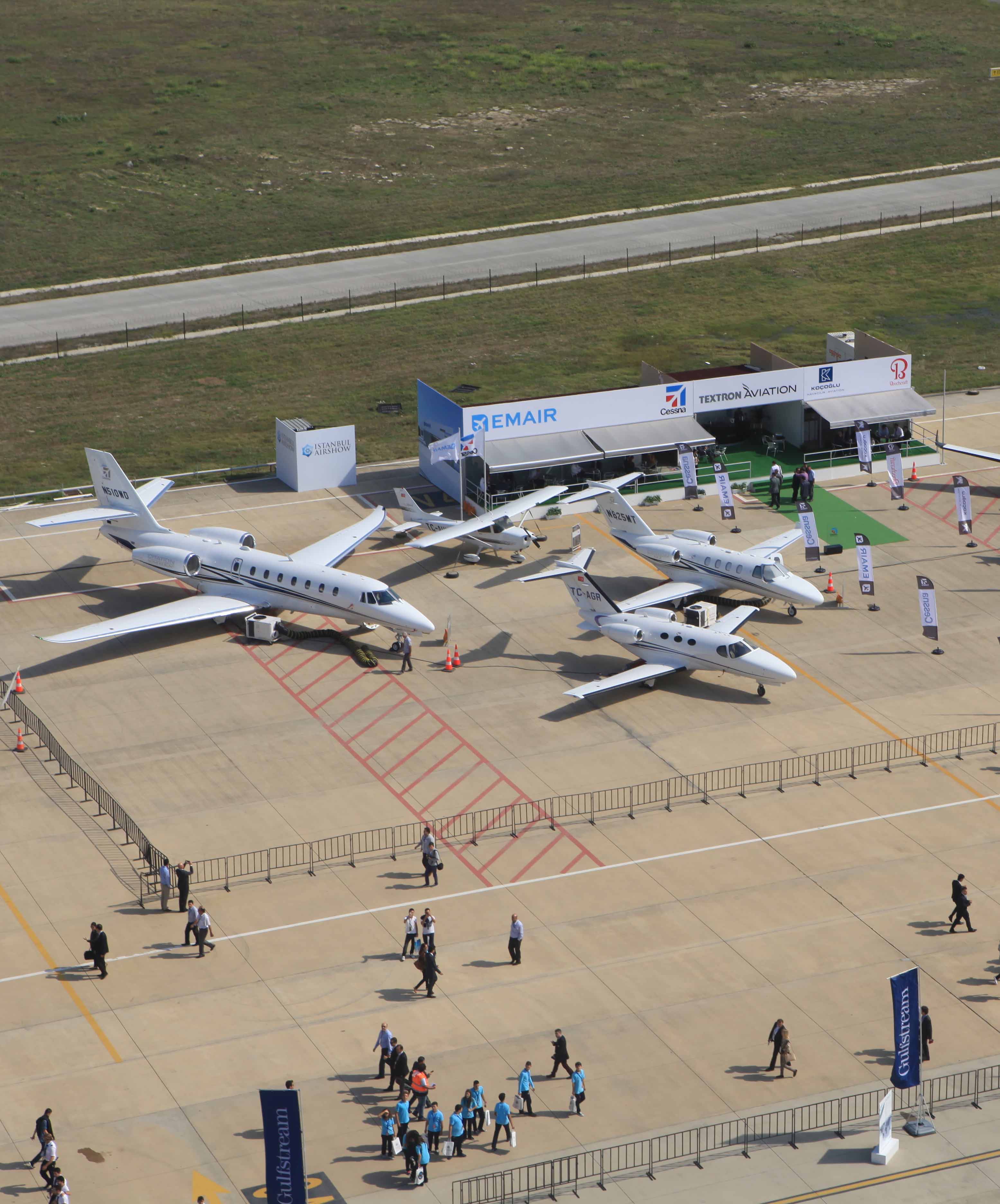
UNIQUE AIRCRAFT DISPLAY OPPORTUNITIES & CHALETS
Istanbul Airshow is unique by offering exhibitors the option to taxi-in
and out anytime during the show except for the opening ceremony hours.
This flexibility also gives the companies the chance to decide on their
initial arrival and final departure dates and times.
Recognizing the challenges associated with confirming the availability
of pre-owned aircraft well in advance of an exhibition, organizers offer
brokers the flexibility to apply for participation and register their aircraft
up to 10 days prior to the show’s opening day. Brokers are only asked to
notify the organizers in advance of the number of aircraft they intend to
display, without any binding commitment on their part.
Subject to timely notification to the organizers and completion of
necessary paperwork by the exhibitors’ service agents, customer demo
flights can be conducted during the show, which is facilitated by the
flexible approach of the General Directorate of Civil Aviation.
Exhibitors participating with a chalet have the privilege of parking their
aircraft directly in front of their chalet, with no limitations on chalet size
or the number of aircraft on display.
To ensure maximum convenience & cost effectiveness, chalet prices
are set as turnkey without furniture. All internal and external works are
included in the prices, provided that the standard materials described in
the application forms are used. The separators and room locations
are planned and constructed per the requests of the exhibitors.
EXHIBIT GROUPS
Aircraft Manufacturers
Aircraft Engines
Avionics
In-Flight Entertainment & Communication Systems
Cabin Interior
Undercarriage
Aircraft Sales, Brokerage, Insurance & Financing
Aircraft & Fleet Management & Charter Brokerage
Aircraft Operations, Flight & Ground Services
Aircraft Maintenance & Overhaul Centers
Flight Training Centers & Simulators
Airport & Terminal Operators & Service Providers
Airport & Terminal Construction, Renovation & Modernization
Aviation Related Institutions & State Entities
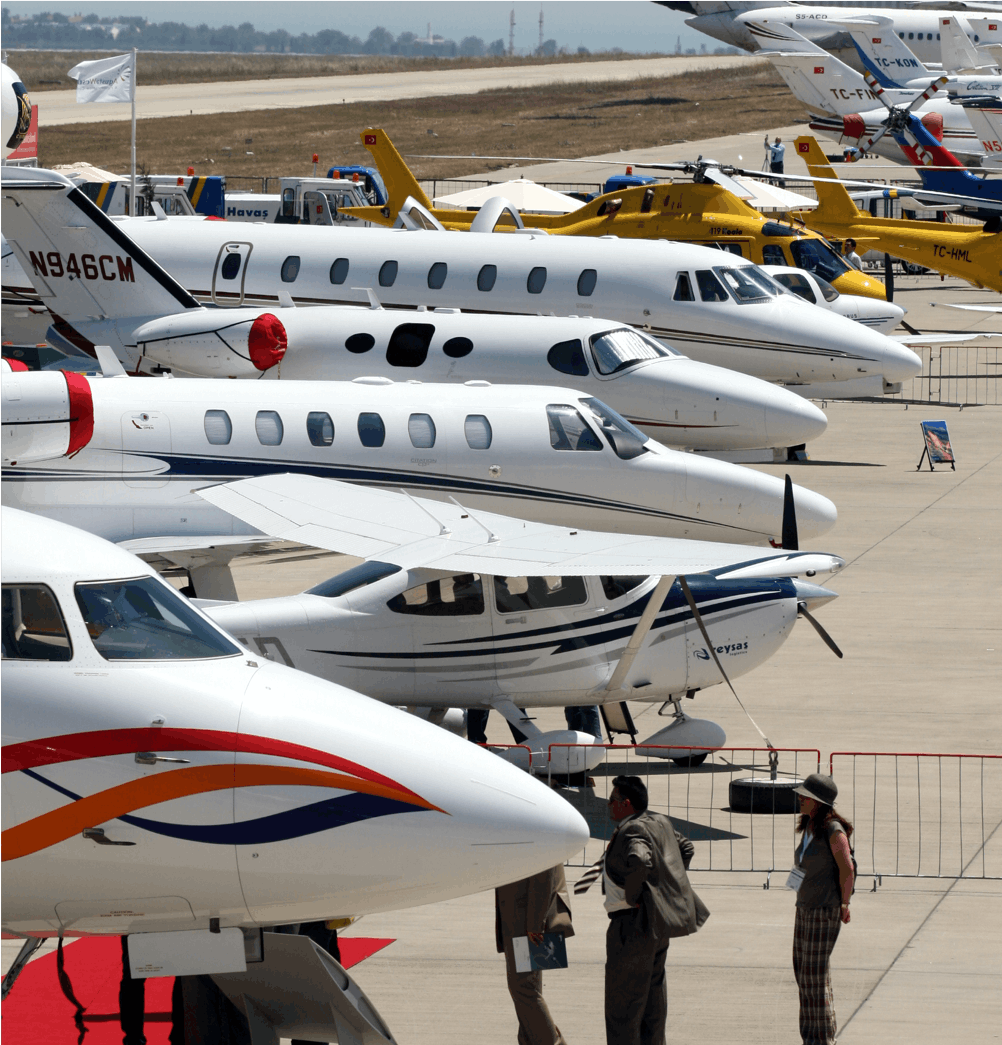
TARGET AUDIENCE
Growth in the global aviation industry is no longer confined only to saturated markets.
It is Rising across North Africa, Rebalancing across the Black Sea corridor, Accelerating through Eastern Europe, and Expanding across the Turkic Republics of
Central Asia. And Istanbul, is not simply the venue. It is the axis linking emerging demand with global capability. With its established role as a global aviation
hub and its geographic reach into multiple high-growth corridors, Istanbul provides the ideal environment to bridge markets that are expanding with the global expertise.
NORTH AFRICA
North Africa plays a strategically important role
in the global business aviation market: its position
at the crossroads of Europe, the Middle East and
Sub-Saharan Africa support positioning flights, on
demand charters and regional connectivity, while
strong demand from energy projects, tourism
and HNW travel drives steady traffic into hubs
such as Cairo, Casablanca, Tunis and Algiers.
Although fleet size and spending are smaller than
in Western Europe or the Gulf, the region offers
growing opportunities in FBO development,
MRO services and specialized crew logistics.
Moreover, fast-growing populations, expanding
tourism, LCC penetration, increasing narrowbody
capacity to serve Europe, the Gulf and Sub-
Saharan Africa and government-backed airport
and terminal development and modernization
projects are reshaping the commercial aviation
and airport industries landscape.
Key growth areas include single-aisle aircraft
programs, leasing solutions, airport technologies,
ground handling systems, digital passenger
services, and line maintenance collaborations.
WIDER BLACK SEA REGION
Russia and Ukraine together form a strategically significant, though uneven, part of the global business aviation landscape. Russia, with a historically large pool of business aircraft, high net worth demands and energy sector travel needs, will be a major regional market if reintegrated. Ukraine’s pre conflict fleet was much smaller, but the country will become important as a conduit for reconstruction activity, executive travel and regional connectivity. If the conflicts are resolved and sanctions/airspace restrictions are lifted, a rapid rebound can be expected.
Large numbers of aircraft will require reactivation, repatriation, maintenance, re-clearance and there will certainly be a significant activity in both the new and pre-owned aircraft markets and charter/ corporate travel will return. Similarly for commercial aviation and airports segments, aviation networks are expected to rebalance and rebuild as the geopolitical clarity improves. Fleet reactivation, route restoration, MRO and heavy checks, spare parts support, aircraft leasing and management, re-certification, insurance and compliance services, FBO upgrades and overall infrastructure rehabilitation are all expected to generate phased but significant demand.
EASTERN EUROPE
Eastern Europe is an increasingly important and
fast-growing region for global business aviation:
a mix of expanding corporate activity, rising
HNW wealth, tourism and tech sector growth
is driving demand for light and mid-size jets,
turboprops and ad hoc charters into hubs such as
Warsaw, Prague, Budapest and Bucharest. While
infrastructure and FBO/MRO coverage remain
uneven outside major cities, the region’s EU
integration, competitive cost base and improving
regulatory alignment present strong opportunities
for FBO expansion, maintenance capacity, pilot/
technician training and digital charter services.
The region is also a very dynamic intra-European
growth corridor fueled by EU integration,
tourism flows and low-cost carrier expansion.
Increased direct connectivity is strengthening the
role of secondary cities in the regional aviation
network which in turn creates the need for airport
upgrades.
TURKIC REPUBLICS OF CENTRAL ASIA
The Turkic Republics of Central Asia; Azerbaijan, Kazakhstan, Kyrgyzstan, Uzbekistan and Turkmenistan form a strategically important, resource driven business aviation region. The demand is led by oil & gas, mining, government/VIP travel and project logistics with major hubs such as Baku, Almaty, Astana, Tashkent and Ashgabat. Majority of the current fleets are composed of light, mid-size jets, turboprops and helicopters. As for commercial aviation and airports industries, energy-backed economies and state-driven infrastructure programs are fueling airport expansion and fleet modernization. Strategic positioning between Europe and Asia strengthens hub development ambitions. With strong resource cash flows, strategic Europe–Asia position and competitive operating costs, there are significant opportunities for building/upgrading FBO’s, VIP handling, development of regional MROs for line and heavy checks, expand helicopter, medevac and charter services, fleet management solutions and local training academies.


